4 days, 3 nights
Amboseli Photography Safari
Dawn and dusk shoots, positioned for elephants and Kilimanjaro.
Amboseli is a BirdLife Important Bird Area, with more than 400 species recorded, including more than 40 birds of prey. The swamps hold herons, pelicans and jacanas, flamingos gather on the swamp lake, and migrants visit from November to April. Bring binoculars.
The Kenya Wildlife Service records more than 400 bird species in Amboseli, including more than 40 birds of prey, and the park is a BirdLife Important Bird Area. Other counts run higher, close to 500. A small park holds so many species because it packs several habitats together. KWS counts five: savanna grassland, acacia woodland, rocky thorn bush, swamps and marshland. For birds, the permanent swamps, the seasonal lake bed, the acacia woodland and the open grass plains matter most, and each has its own species.
You do not have to be a birder to enjoy them. Many of Amboseli's best birds are big, bold and close to the road, and they fill the quiet minutes between mammal sightings.
The Enkongo Narok and Longinye swamps, fed by Kilimanjaro's underground springs, are the heart of Amboseli's birdlife. Stop at the water edges and scan slowly with binoculars. Wildlife such as hippos and buffalo share the same spots, which is why an elephant drive and a bird drive often happen together.
Swamp birds to look for in Amboseli
| Bird | Where | Why look |
|---|---|---|
| Pelicans | Swamp edges and shallow water | Often seen in groups, easy for beginners |
| African jacana | Floating plants in the swamp | Walks on lily pads on long toes |
| Grey crowned crane | Wetland edges, often in pairs | Elegant gold crest, easy to photograph |
| Herons, egrets and goliath heron | Swamp pools and reeds | Look for the huge goliath heron |
| Long-toed lapwing and water thick-knee | Swamp margins | Local waders for keen birders |
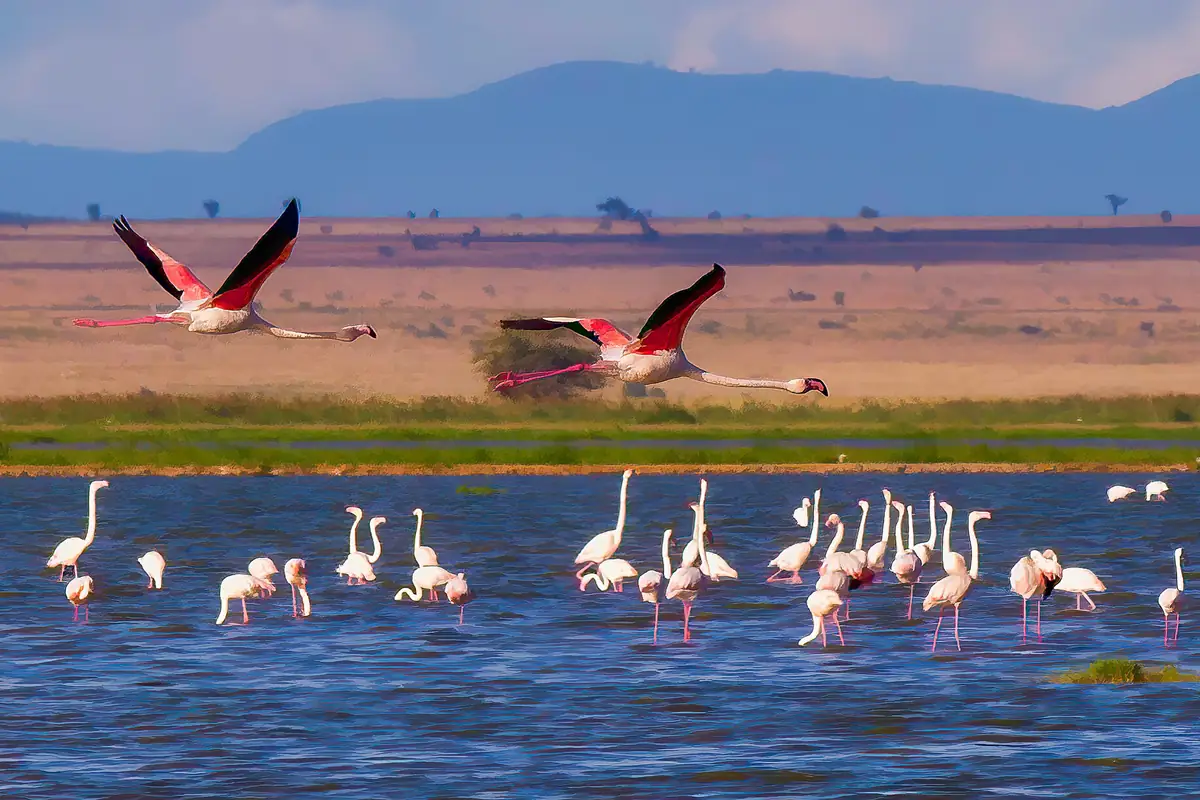
| Greater and lesser flamingo | Enkongo Narok swamp lake and flooded pans | Pink flocks, peak numbers in the rains |
| Taveta golden weaver | Swamp vegetation | A resident of south-eastern Kenya and neighbouring Tanzania, listed by BirdLife for the park |
Yes, often. In recent years the Enkongo Narok swamp has filled to become a lake, and it has hosted large flocks of greater and lesser flamingo. KWS lists Lake Amboseli and the flamingos it attracts among the park's attractions. Lake Amboseli itself is a temporary lake in an old, dry lake basin. It is dusty for most of the year and floods after heavy rain.
We never promise flamingos, because water levels decide where they gather. Bird guides report that numbers peak in the two rainy periods, March to May and November to December. Ask us about conditions before you book, and see our best time guide for the seasons.
KWS counts more than 40 birds of prey, and the open plains and tall trees suit them. Species to look for include the secretary bird, which hunts on open grassland, the martial eagle, the African fish eagle near water, and several vultures. Scan the tall trees and the open ground, because raptors perch and watch from there.
The plains hold ostrich and the kori bustard, a heavy ground bird that is hard to miss, along with Hartlaub's and white-bellied bustards, the local Pangani longclaw and the spike-heeled lark. The acacia woodland adds dry-country birds: yellow-necked spurfowl, Von der Decken's hornbill, white-bellied go-away-bird, steel-blue whydah and white-headed buffalo-weaver. Fischer's and Hildebrandt's starlings add colour near camp.
Birds are here all year, and the style changes with the season. Migrants visit from November to April, and bird guides rate December to March as the best stretch for birding. Rain is more likely to disrupt drives in November and April. Wet months fill the swamps and the lake bed, which suits waterbirds and flamingos.
The dry months have their own advantages: easy roads, concentrated water and clear views over open ground. Resident birds are easy to find in every month. For the full month-by-month picture, see our best time guide.
Birding guides list a handful of Amboseli specials. They include the Pangani longclaw, a localised grassland bird, and the Taveta golden weaver, a near-endemic of Kenya and neighbouring Tanzania. Others are the rufous-bellied heron, Dickinson's kestrel, rufous chatterer, spike-heeled lark and African swamphen. The common redshank is a migrant wader that visitors can see in the northern winter.
BirdLife has also noted that the swamp area has expanded greatly in recent years, which has increased numbers of waterbirds, while woodland of fever trees has declined. Bird numbers and species shift with water, and a guide who drives these tracks often will know what has changed this year.
Binoculars matter most, and 8x42 is a good size. A field guide to the birds of East Africa helps you name what you see. For photographs, a lens of 300 to 400 mm and a beanbag on the vehicle window do most of the work. Bring a soft cloth for dust. Our vehicles have pop-up roofs, so you can stand and scan with a clear view, and we stop for as long as you want.
Our Amboseli Photography Safari suits bird photographers, and our 3 Day Amboseli Safari gives you a full day at the swamps. The 2 Day Amboseli Safari is a good first taste.
Yes. A jacana walking on lily pads, a secretary bird hunting on the grass and a kori bustard striding past are good reasons to look down from the elephants for a minute. Tell us you like birds and we will slow the pace, point out the highlights and keep a list as we go.
Safaris to consider
4 days, 3 nights
Dawn and dusk shoots, positioned for elephants and Kilimanjaro.
3 days, 2 nights
A full day at the swamps and Observation Hill, with two dawns for Kilimanjaro.
FAQ
KWS records more than 400 bird species in Amboseli National Park, including more than 40 birds of prey. Counts for the wider ecosystem run closer to 500.
Flamingos are often seen in Amboseli but never guaranteed. In recent years large flocks have used the Enkongo Narok swamp lake, with numbers peaking in the rainy periods, March to May and November to December.
The best time for birdwatching in Amboseli is November to April, when migrants join the residents, and December to March is widely rated best. Resident birds are easy to find all year.
The Taveta golden weaver is the Amboseli bird specialists look for, a restricted-range swamp species. Grey crowned crane, African jacana and kori bustard are the crowd-pleasers.
Birding in Amboseli starts when the gates open at 06:00, and the best hours are about 06:30 to 10:00. Stay in the park overnight to be out at first light.
Send us a WhatsApp message or an email with your dates and group size. We reply with a clear plan and price.