Amboseli elephants
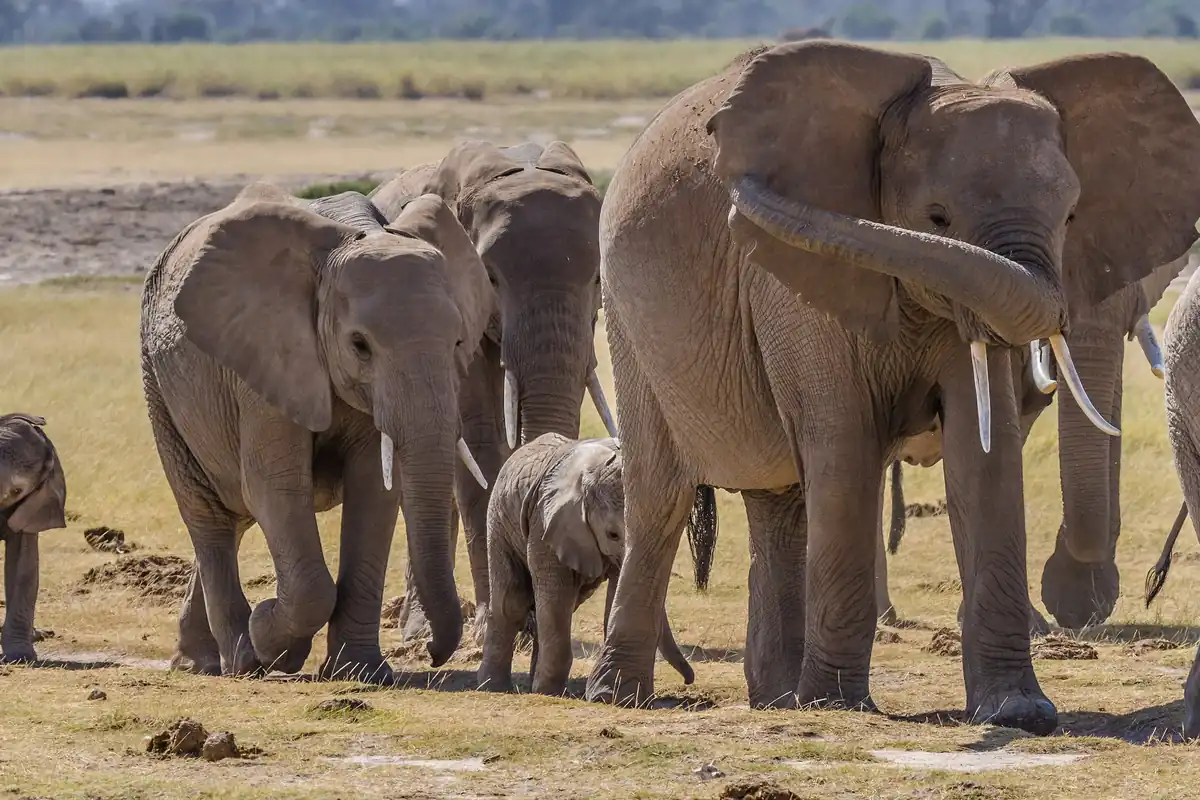
Amboseli is one of the best places in Africa to watch wild elephants up close. The Amboseli Trust for Elephants has followed individual elephants here since 1972, in the longest running study of wild elephants. The swamps draw big family herds in the dry months, and old bulls with huge tusks still roam.
How many elephants live in Amboseli?
The Amboseli Trust for Elephants (ATE) knows every elephant in the Amboseli population by sight. At the end of 2023 it counted 1,878 living elephants, at the end of 2024 it counted 1,903 in 65 known families, and at the end of 2025 the figure was 2,065, after more than 220 births in a single year. That baby boom followed the 2022 and 2023 drought, because an elephant pregnancy lasts about 22 months.
These numbers cover the whole ecosystem, which spreads over roughly 8,000 km² across the Kenya and Tanzania border, not only the 392 km² national park. ATE's 2024 report notes that there are rarely more than 400 elephants in the central area at any one time. The rest are out on Maasai group ranches and conservancies, or across the border.
Why are there so many elephants in such a small park?
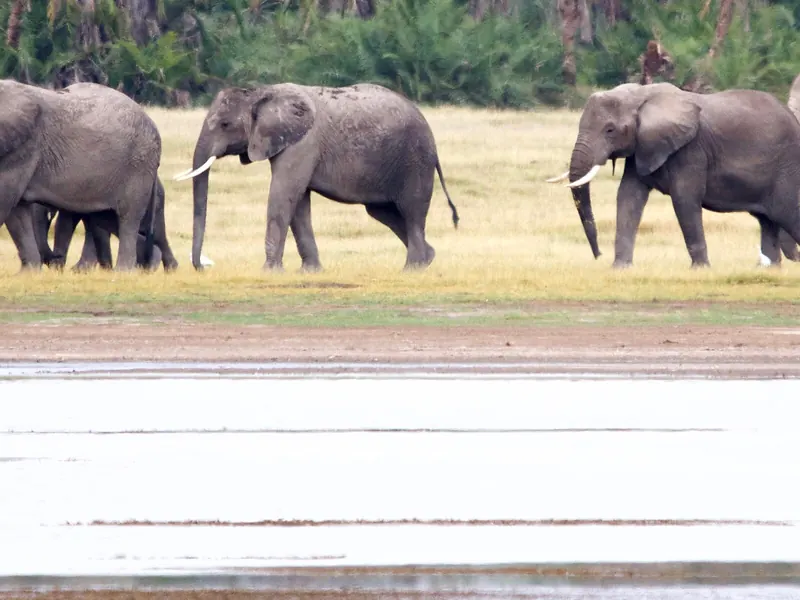
The answer is water. Two permanent swamps, Enkongo Narok and Longinye, are fed by springs that rise from Kilimanjaro's underground aquifers. In a basin that gets only about 350 mm of rain a year, they are the dependable green heart of the park. From June to October the herds converge on them, and the elephants wade, drink and feed for hours in the open.
When the rains come, the herds spread out. Several families commute between conservancies such as Selenkay and the central swamps. ATE credits Maasai landowners and the Kenya Wildlife Service for keeping this wider range open. Researchers also link the loss of the old fever tree woodland, in part, to elephant browsing, one of several explanations. It is a reminder that this is a living, changing landscape.
What is the history of elephant research in Amboseli?
Amboseli is home to the longest running study of wild elephants ever undertaken. Cynthia Moss and Harvey Croze began it in 1972. They recognised individual elephants, gave each family a letter code and recorded every birth, death and relationship. More than 50 years of continuous records now document the lives of more than 3,500 elephants.
Amboseli elephant research: key moments
| Year | Milestone |
|---|---|
| 1968 | Cynthia Moss leaves a job at Newsweek in New York to study elephants in Lake Manyara, Tanzania, with Iain Douglas-Hamilton. |
| 1972 | Moss and Harvey Croze start the Amboseli Elephant Research Project. The first families are identified, including the AA family led by Wart Ear. |
| Early 2000s | The project becomes a legal entity, the Amboseli Trust for Elephants (ATE), to support the work. |
| 2009 | Echo, matriarch of the EB family and the best known elephant in the study, dies. Her family had grown from seven members to 37. |
| 2015 | ATE launches the Elatia Project. Elatia means neighbour in Maa, the language of the Maasai. |
| 2020 | Tim, one of Kenya's last great tuskers, dies of natural causes aged about 50. |
| 2024 | A paper with ATE researchers among the authors reports that African elephants appear to address one another with individually specific, name-like calls. |
| 2026 | Craig, the famous Amboseli super tusker, dies of natural causes on 3 January, aged 54. |
Moss has written about the elephants in books such as Elephant Memories and Echo of the Elephants, and has made award-winning documentaries. ATE also trains African elephant researchers, funds scholarships for Maasai students and works with the community on coexistence.
What has the research taught us about elephants?
The records show a society built around females. A matriarch leads each family, and the older elephants hold social and ecological knowledge: where to go, what to eat, how to avoid danger. ATE has also documented what drought does. In its 2024 report it records 179 elephant deaths in 2022 and 67 in 2023, with calves and older animals hit hardest, then a strong recovery when the rains returned.
Males leave their family groups as they mature, and the study follows them as they roam the ecosystem and into Tanzania. Group size flexes with conditions. In the very wet year of 2024, females were most often seen in groups of 20 or more, and the largest gatherings topped 300 elephants. When you watch a herd at the swamps, you are watching animals that researchers have followed, in many cases, since birth.
Who was Echo?
Echo led the EB family and became the most researched elephant in the world. ATE calls her possibly the most famous elephant ever. She was followed for almost four decades and died in 2009 at about 60 years old. Her story reached millions through books and the television series Echo of the Elephants. The EB family she led is still followed in Amboseli today.
Can you still see big tuskers in Amboseli?
Amboseli is known for its tuskers, bulls whose tusks grow so long that they reach the ground. Two names stand out. Tim died in 2020 aged about 50, with tusks that each weighed more than 45 kg. Craig was born in January 1972 to Cassandra of the CB family and died in January 2026 aged 54, with tusks that each weighed more than 100 pounds. He was known for his calm nature. A January 2026 report put the number of known super tuskers left in Amboseli at nine.
We cannot promise a tusker on any drive. These bulls range widely, and Craig died on Maasai community land outside the park. What we can promise is a guide who knows the swamps, listens for news from other drivers and scans every herd. Big bulls still walk the Amboseli plains, and a patient morning at the swamps is the best way to meet one.
When and where is the best place to watch elephants?
- Season: June to October for the biggest concentrations, and April to July for the youngest calves, since births peak from March to June.
- Time of day: early morning and late afternoon, when the herds feed in the open and the light is soft.
- Place: the Enkongo Narok swamp edges, the Ol Tukai woodland and the view from Observation Hill, where you look down on the herds.
- Backdrop: Kilimanjaro behind a feeding herd is the classic Amboseli frame. See our Kilimanjaro views guide.
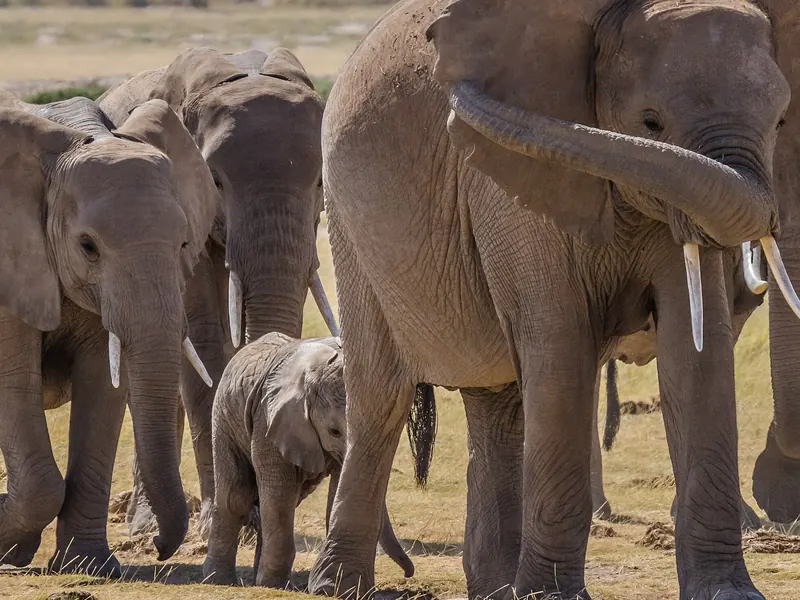
Our 2 Day Amboseli Safari and 3 Day Amboseli Safari put you at the swamps at the right hours, and the Amboseli Photography Safari is built around the light. Short on time? The Amboseli Day Trip from Nairobi gives you about five hours with the herds.
How do we watch elephants responsibly?
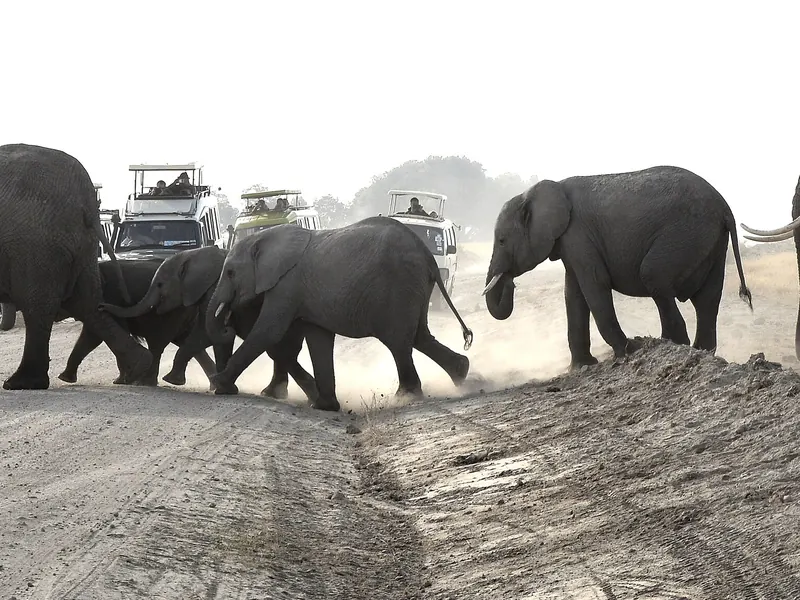
The Kenya Wildlife Service rules protect both elephants and visitors. We stay in the vehicle, keep at least 20 metres from the animals, drive no faster than 40 km/h, stay on established tracks and never block a herd's path. We switch the engine off at a sighting and let the elephants set the pace. Your guide reads ear and trunk signals and will back away before a bull or a mother feels crowded. Quiet vehicles and patience give you closer, calmer sightings than speed ever will.
For the rest of the park's animals, read our Amboseli wildlife guide, and for timing, the best time guide.
Safaris to consider
Plan it with us
3 days, 2 nights
3 Day Amboseli Safari
A full day at the swamps and Observation Hill, with two dawns for Kilimanjaro.
4 days, 3 nights
Amboseli Photography Safari
Dawn and dusk shoots, positioned for elephants and Kilimanjaro.
FAQ
Frequently asked questions
How many elephants are in Amboseli?
The Amboseli Trust for Elephants followed 2,065 individually identified elephants at the end of 2025. They range across an ecosystem of about 8,000 km², so you will not see them all in the park at once.
Who studies the Amboseli elephants?
The Amboseli Trust for Elephants, founded from the Amboseli Elephant Research Project that Cynthia Moss and Harvey Croze began in 1972. It is the longest running study of wild elephants.
Can I see a big tusker in Amboseli?
Possibly. Amboseli is famous for tuskers, but they roam widely and sightings are never guaranteed. Craig, the best known, died in January 2026. A guide who knows the swamps gives you the best chance.
When are there baby elephants?
Amboseli elephant births peak from March to June, so calves are easiest to see from April to July. Calves are present all year.
How close can we get to the elephants?
KWS rules require at least 20 metres from Amboseli elephants, and we stay in the vehicle. Elephants often come closer on their own, and switching off the engine lets them pass calmly.
Ready to plan your Amboseli safari?
Send us a WhatsApp message or an email with your dates and group size. We reply with a clear plan and price.